Showing posts with label Book Review. Show all posts

Wednesday, May 21, 2008

Scrapbook Page Maps

I have known about Page Maps since I started scrapbooking but it wasnt't until recently that I started fully utilizing them. It was an amalgamation of many things, including the fact that the sketches now tell you the size of the photos needed. No more guesswork! No more taking out my magnifying glass and ruler, trying to convert the small sketch into 12x12 scale. There was also the realization on my part that if I wanted to make a dent on my scrapbooking backlog, I will have to make more multi-photo layouts. And I do not want to waste my time trying to determine photo size, placement, etc., when I can have the experts do that for me. I'd rather be playing with my paper and tools than just moving things around endlessly, hoping that things will fall into place...eventually.

One might ask, why would I need to buy Becky Fleck's Page Maps book, when I can go to www.pagemaps.com for her sketches or just wait for her regular column at Memory Makers? Why indeed?

Well, for starters, the book includes 60 never-before seen sketches. It is also unlikely these sketches will be used in the website or in the magazine. So the only chance you have of seeing these sketches is if you get the book. Second, you don't have to waste ink printing out the sketches and accompanying sample layouts, they're all here for you in a durable ring-bound book that you can lay flat on your table as you scrap. No more worrying that your book binding might fall apart. Or putting your cell phone on a page so you won't lose your place. And third, you get more inspiration from the many amazing layouts, and tips and techniques included in the book.

Becky Fleck explains her, and her guest artists' approach to the sketches, which you cannot find in the website. She gives tips on how to make the sketch your own. Also scattered throughout the book are step-by-step instructions on how some techniques were used in the layouts. The layouts also want me to bring out my scrapbooking tools and start scrapping, right here, right now.

One thing I look for when I buy scrapbooking books - do the layouts call to me to scraplift them in part or in full? (Might just be a technique, an accent, etc.) I know that some scrapbooking purists don't think highly of scraplifting or basing their layouts on sketches. Maybe, they just do not understand it's value. In fact, when my DH bought the book for me, he texted me to make sure it was the book I wanted. Bakit daw puro diagram ang laman ng libro. Well, I said, those diagrams make my scrapbooking life easier. And contrary to purist belief, they jumpstart my creativity instead of stifling them. Following a sketch doesn't mean being boxed in.

For instance, there are 60 sketches in the book. But there are 140 layouts by amazing artists. 60 sketches = 140 layouts. And no layout exactly or even remotely alike. The math doesn't seem right, does it? Well, it only proves the versality of sketches. A single sketch can be interpreted many ways, depending on how you use it. You can flip it, rotate it, keep it as is, change the elements as you see fit. You can convert a 12x12 into an 8 1/2 by 11, or even a spread into just one page. The sketch may have been provided for you but you, the scrapbooker still has to decide on which photos, papers, embellishments, etc., to use. You still have to make sure everything goes well together, and that is where the fun lies.

If you are not still convinced, the book also includes a set of travel-sized cards that you can easily bring to scrapping sessions. You do not have to bring the book, unless you want to show off to your friends that you have the latest Becky Fleck.

Scrapbook Page Maps: Sketches for Creative Layouts
Author: Becky Fleck, 2008
Publisher: Memory Makers Books
MSRP: $24.99

Friday, March 09, 2007

The Journaler's Handbook


The Journaler's Handbook by Tracy White comes in an attractive three-fold binder that contains an audio CD, the main book and a blank journal. Minus the time I spent analysing the included layouts, this book was a quick read.

The main handbook is not meant to be read through as more than half of it consists of journaling prompts. The questions go beyond the usual 5Ws and H (who, what, where, when, why and how) we were taught in Journalism 101. It is a handy reference to have on your scrap table, for those moments when you have writer's block. The prompts are arranged by theme - baby, child, teen, adult, everyday life, relationships, school, birthdays, travel, holidays, and heritage. So instead of spending the precious little time we have to scrap thinking of meaningful journaling we could quite easily turn to the page that suits our LO.

Those of us who are quite confident in our journaling may not immediately see the need for this book. But the book asks around 100 questions per theme, surely there is one question there that we haven't thought of asking ourselves? The answers could only make our writing more interesting. And if like me, you are scrapping photos from way back when, the memory triggers will help bring back information beyond that which is obvious from the photos. After each chapter, Tracy also gives suggestions on how to complete a page, like adding and collecting ephemera to support your journaling.

The CD is a 30-minute (or thereabouts) workshop/discussion on journaling that you can listen to while you are driving or scrapping. You can close your eyes (NOT - when you're driving, please) and pretend that you are attending Tracy's "Write from the Heart" class at Creating Keepsakes University.

The journal is like a slum book, with questions like what books do you like reading or what is your favorite food or drink? It's up to you whether you would want to use it, but the value, I think lies in the exercise and in plumbing your deepest thoughts from your mind.

Monday, March 05, 2007

The BIG Picture - Part 2

I finished reading the book today. I plan to analyse and internalize each and every layout next. In the meantime, here are more Big Picture gems from Stacy Julian:

*Scrapbooking is not a science. It's a dynamic changing collection of your life's stories.

*Don't stress about letting pictures sit - it's okay, and maybe, even good.

*Things don't always have to be so straight. And it's okay to just cover up mistakes.

*DON'T MAKE IT HARD!!!

*Remember, the size, shape, and ultimate resting place of a scrapbook memory is less important than the fact that you did what felt right.

*SIMPLE SCRAPBOOKING is the permission you give yourself to scrapbook what's most important to you, when it's most important.

If you think I've shared all the secrets of the book for you, then you have another think coming. There are more things to learn from The Big Picture. I know that in the next few days, I will keep the book within reach so I can review it. This is one book I will always want to refer to as I grow in this hobby. (Hmmm...maybe I should get my own copy then. Hahaha.)

I like how the book just segues seamlessly into the heart of scrapbooking. Stacy Julian starts by sharing her layouts (and her life) and you begin to think, "Oh, yes, that's what's important." As I read the book, I find myself nodding and smiling and having what Oprah calls "A-ha!" moments. And Stacy is not even giving you a lecture. She just shares what works for her. And truly, it should work for every Ms. Scrapper who doesn't want the unnecessary work, stress, and expectations that sometimes comes with the territory. (Think comparing your work with others'.) But take a look at Stacy's work. They're really quite simple, not too many accoutrements, but they all tell the story. Which is what our scrapbooks should do. Tell our stories to our own.

There is one thing though that Stacy wrote that I disagree with. She wrote, "Scrapbooking is cheap therapy." Hmmm....not really. And especially not if you're from this part of the world.

Thanks, Nita, for trusting me with your precious copy. I can now see the big picture, and it's just wonderful.

Sunday, March 04, 2007

The BIG Picture

I am now reading Simple Scrapbooks' The Big Picture by Tracy Julian. This was published in 2005, but the words still ring true now as they must have then. Only in page 50 and I am reminded that:

*Scrapbooking is about your most important memories, not about the many pictures.

*You create because you feel compelled to do so, not because you have a place for it to go. (Aha! I don't really have to worry about making theme albums.)

*Scrapbooking products don't have an expiration date. (I say, yeah! Who knows and cares that I bought most of my stuff in October 2004 and am only using them now?)

*Anytime you hear yourself say, "I wish I had..." look around and say, "What if I...?" (I see necessity is the mother of invention in scrapbooking, too.)

*You can change your approach anytime you need to. (Score! This is not SODOKU.)

*If a design works for you once, do it again. (So if my page 2 is the same as my page 15, it would only mean it's still as pretty as it was the first time. Hmmm...if a design works for others, scrap lift. Hehehe.) Also, you can scrap a photo more than once.

*This wonderful hobby needs to work for you - not the other way around. (Hmmmm...it shouldn't even be called work.)

*Journaling doesn't always have to be "composed." Just write. (No more drafts and re-drafts. This is not a career in journalism. LOL.)

*You don't always need an obvious title for every page you create. (Alleluia for those times when I can't think of the perfect punchline!)

*If you love it, it ought to be part of your scrapbook. (Expect an LO about this book. Grin.)

*You can incorporate childhood photos into your current scrapbook to tell a story about you. (Those photos are coming out of their magnetic homes.)

*All our kids really need are the highlights, not all the pictures of events, etc. (Thank, God.)

And at this scrapbooking stage I am now in, these really make me stop and take stock:

"Remember, it's paper, pictures and glue - you can afford to experiment and discover and make mistakes."

Whew! That takes off a huge load called expectations from my shoulders.

"Everything changed the day I realized I have exactly enough time to scrapbook my most important memories."

I don't have to stress over my kids' baby pictures I haven't scrapped or that I added more to my "backlog" with last Saturday's party pictures. In fact, don't even say the word backlog or never being caught up. Who's putting me on a deadline anyway?

No rush, no hurry, just the pleasure of scrapbooking my life as it unfolds. I am so loving this book and I can't wait to read more.

Tuesday, January 23, 2007

Review: Photography for Scrapbookers

Photography for Scrapbookers
Tracy White, Creating Keepsakes, Primedia, 2006


No, I didn’t purchase this book. I only borrowed it from friend and fellow scrapbooker, Nita. Not because I was too cheap (huh!) but because I seriously believed I didn’t need it. I have dabbled in photography since high school, and even took a photography course when I got my Nikon FM2, a fully-manual SLR. It’s safe to say I know about f-stops, apertures and ISOs. So no, I was not interested in another photography book.

Professional photographers will find the tips and techniques in the book common sense or purely intuitive. But for beginners, it is a good resource. It gives advice on taking every day pictures, portraits, places, nature and landscapes, holidays and special occasions and action. There is also a section of helpful hints for photographing babies, toddlers, children, teens and adults. I like how the book presents photos by different photographers and how it discusses their individual approaches. The approaches are practical and easy to follow. No f-stops and aperture settings to confuse you or make your eyes glaze over.

I am neither a professional nor a beginner but I still found some value in this book, particularly on lighting and composition. It guides you to take photos that tell all the details of the story. It’s not just taking photos, it’s taking photos that would look good in your layouts. In fact, just looking at the photographs inspires me to grab my camera and take photos. Something I have come to think of lately as a chore more than a fun activity.

These days, I use my point and shoot digital camera more often than my trusty FM2. It is easier to lug around and I love the convenience of being able to preview the shot immediately after it was taken. Not to mention, no film costs. I am frustrated, however, that my digital camera has no manual controls. The book reminds me to use the different scene modes in my camera. It tells me when to use these settings. So for now, I am quite happy with what I have (though I won’t stop wishing for a Nikon D80).

The best prcatical advise in this book? Read your camera manual. It is not as exciting to read (or look at) as this book but it tells you what your camera is capable of. Then practice, practice, and practice some more. Take more pictures than you will ever need. Then choose the best photos of the lot. And remember, you don’t have to scrap them all.

Monday, August 28, 2006

Scrapbooking Books: Review

When I shopped for my scrapbooking stuff last year, I also picked up a book on scrapbooking. I didn't have any idea which publishers were good so as usual, I let my nose guide me to the sales stacks. This was the only book I saw.


Not really THE ultimate

The book is hardbound and very thick and was published way back in 2000 so my first thought was the precious real state it was going to occupy in my luggage. But my DH convinced me to get it so I would at least have one reference for when I scrapbook. The Ultimate Scrapbooking book is not really the ultimate because it was written prior to 2000. Some of the layouts were made in 1996-1998, so there are many new tools and supplies not covered here. The book gives a listing of the materials and supplies you need to make a featured layout, along with step-by-step instructions. While I found the techniques on matting, framing, lettering, etc., useful, I don't open the book that often because simply put, the featured layouts are not that exciting or inspiring. I wouldn't really recommend this book to anyone.

My sister Marissa is the one who knows her scrapbooking books. She very thoughtfully included two scrapbooking books from Creating Keepsakes to my shipment of scrapbooking goodies last summer.


If you should ask me what book you should bring in case you were snowbound in a log cabin with nothing but scraps around, this book would be it.

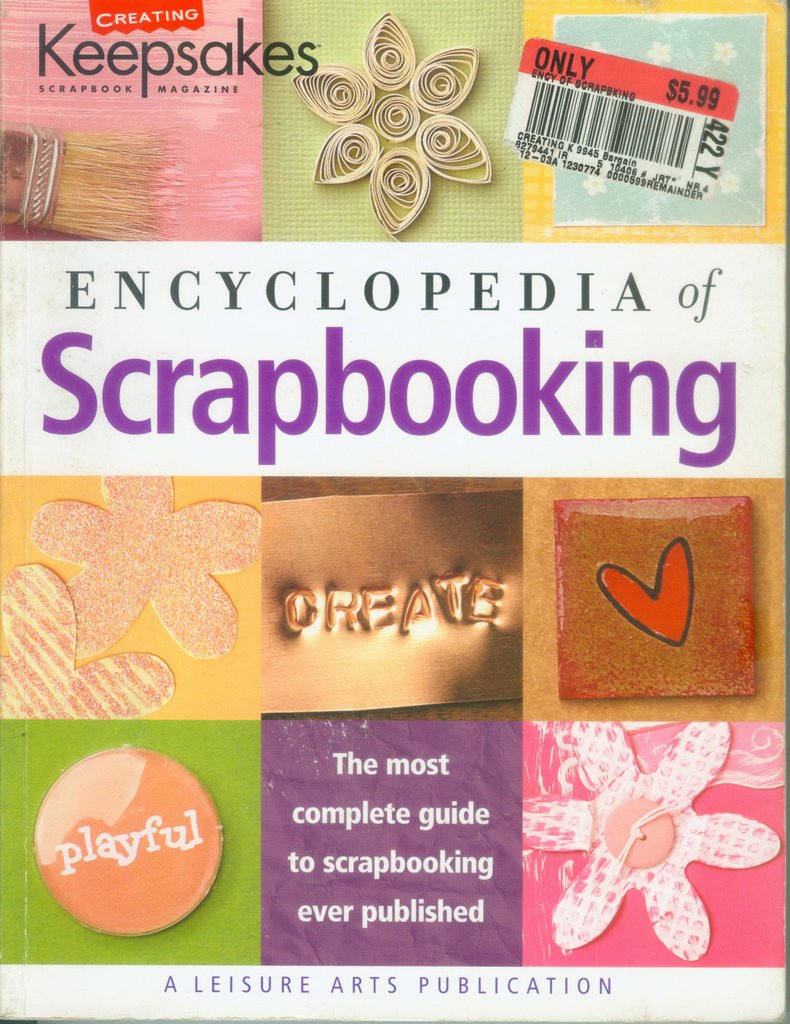
The Encyclopedia of Scrapbooking (Leisure Arts, Inc.; 2005; $5.99 on sale) is a must-read and must-have for all scrapbooking newbies. It discusses scrapbooking fundamentals, moving on to beginning embellishing to intermediate and then to advanced embellishing. Every other page presents a technique - from using a paper trimmer to heat embossing to stamping and machine stitching. Anything you can possibly think to do, it's taken up in this book. Each technique is adequately described and wonderfully illustrated. The featured layouts are so perfect you would be tempted to make one on your own. And why not? With this book as a guide, you would be making beautiful pages in no time.


Who says you can't teach new tips and tricks to old dogs like me?

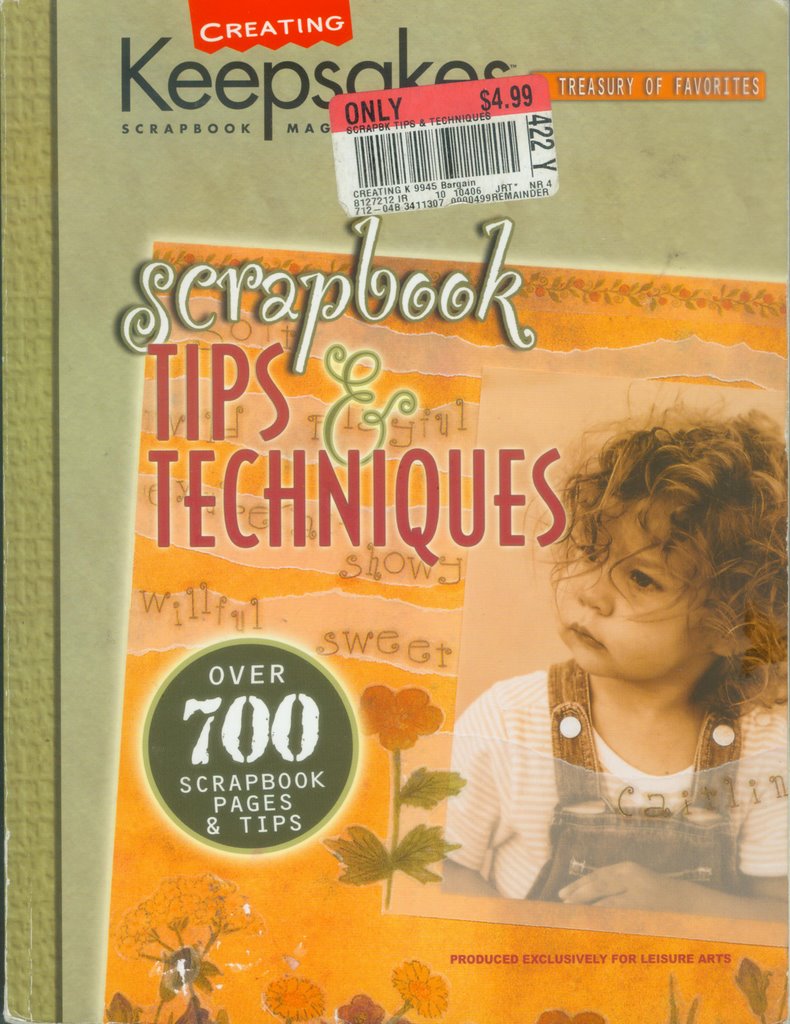
Scrapbook Tips and Techniques, also by Leisure Arts Publication (2004; $4.99 on sale), is a good companion to the aforementioned Encyclopedia. Once you're feeling confident about your scrapbooking, you can add on by using the tips and tricks featured in this book. The book has chapters on cooking up quick pages, sketches by Becky Higgins, journaling and as a bonus - 50 favorite quotes. The layouts are also awe-inspiring. I am very much tempted to scraplift each and every page.


A jewel dug up at the Booksale in Robinson's MetroEast


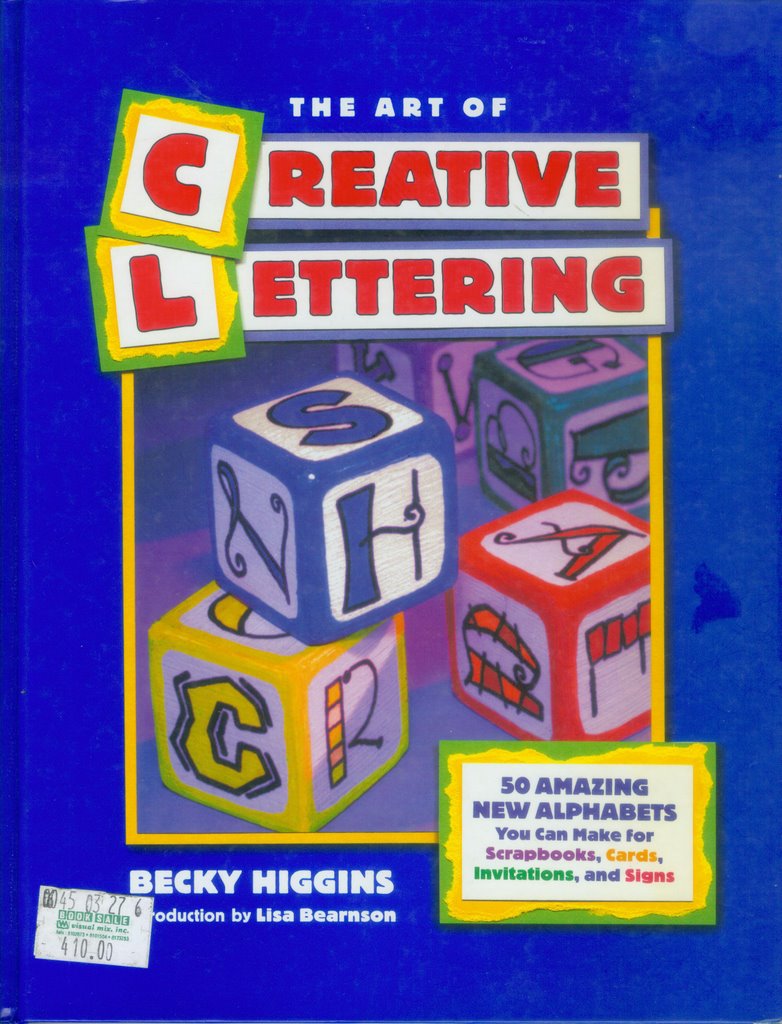
The Art of Creative Lettering (Becky Higgins, 1999, P410 on sale) is an old publication by Creating Keepsakes. The newer CK publications on lettering now come with a fonts software CD. But for those who like the appeal of hand-written titles and journaling in their layout, this book is a good resource. It features 50 fonts that can be used for scrapbooking and cardmaking. Becky Higgins illustrates six basic structures that can be easily modified into other designs. The letters contain the numbers from 1 to 9 and both upper- and lowercase letters. While I don't like my own handwriting much, the book can almost make me believe that with a squiggle here and a curlicue there, I could produce such decorative titles.


Pages upon pages of groovy gift wrap of the 1960s

This last book has nothing to do with scrapbooking but my DH lent it to me as a reference for matching colors. The 1960s is known to be the most "visually far-out and faddish of decades." I look at this book and think, oh, why, oh why, couldn't they make patterned paper for scrapbooking like these?

Of course, in the end, nothing can replace watching real people actually using the tips and techniques featured in these books. Or the value of taking up the cudgels, or in this case, your tools, and decisively making layouts. Tools and books can only get you so far. What matters is how you apply them.

Happy scrapbooking!